Client · 2026

A website job for a North York laundromat that became a portal for its business clients and staff.
01
Hired for a Website
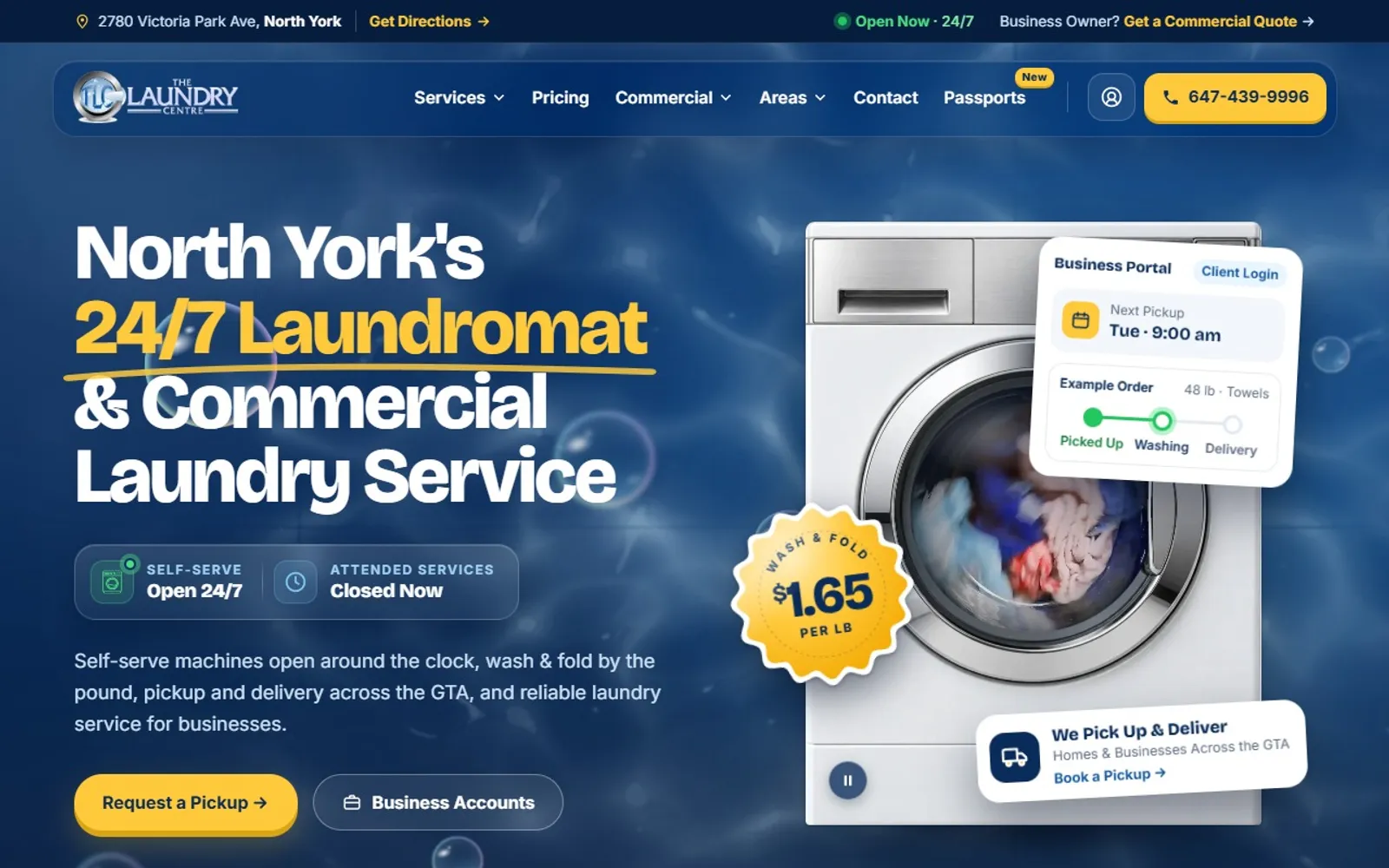
The Laundry Centre is a laundromat in North York. Its owner hired me to redesign the website, and the work grew into marketing. Alongside home customers, the shop washes for gyms, spas and clinics.
Those commercial accounts were the part he wanted more of. He kept coming back to one question: how do I grow the commercial side? I owed him a straight answer before I built anything else.
02
An Honest Answer
The easy reply would have been an ad budget. I wrote him an email instead, and the core of it was this.
“This isn't really an advertising problem. A $20–40k/year contract doesn't get won by ads, it gets won by a sales process. There are only a few hundred gyms, spas, clinics, salons, and restaurants in your delivery area.”
So I proposed two halves. One was a sales engine to find and reach those few hundred businesses. The other rebuilt the website as a sales tool, centred on a portal for commercial clients.
The portal was meant to be something he could pitch. Against the big linen companies, he could say "every one of my commercial clients gets their own dashboard, request a pickup in ten seconds."
03
A Site Built to Win Accounts
I designed the new site around one goal: a business applying for a commercial account. Home customers still find prices, hours and pickup requests quickly. Every business page, though, leads toward that application.
The homepage offers business accounts right beside home pickup.
The commercial page explains the service and previews the portal a client gets.
The application asks what a quote needs. This gym is made up, and nothing is sent.
Gyms, spas and hotels each get a page that speaks to their laundry. Neighbourhood pages cover the delivery area. A visitor can see the client portal preview before they ever apply.
Each industry has its own page. This one is for gyms.
It starts with a gym's problems in its own words, then what it gets.
Then what gets washed, and a pickup schedule set with the gym.
Winning an account was only half the problem. Behind the counter, the owner still tracked orders on paper. A dashboard for clients needed real orders behind it, so the portal had to run the shop too.
04
One Portal for Everyone Else
I built one app for everyone who isn't a website visitor. Business clients, drivers, counter staff and the owner share one sign-in and one look. Each role sees only the tools it needs.
A client opens a dashboard showing their next pickup. They can skip a day, pause service or ask for a change. Each order has a timeline, and a problem can be reported from it.
Each order shows where it is, step by step, and when it's due back.
A finished order keeps who delivered it and when.
A problem is reported from the order itself. This one is never sent.
Staff start from a Today screen with the day's route, stop by stop. An order board and weigh sheets replace the paper the owner used. The owner's admin holds applications, clients, pickup windows and prices.
A driver's day: the route by window, with the next stop pinned to the top.
A pickup is marked done in two taps, with Undo in the toast.
At the counter, an order is weighed on a keypad and moves on to Ready.
The owner set the bar himself: it should feel like Apple, Uber or Airbnb. So actions happen at once, with no confirm dialogs. A toast offers Undo, and staff can still reverse a step for 15 minutes.
The dashboard leads with the next pickup.
Skip This Pickup works at once, with no confirm dialog, just Undo in the toast.
Undo puts the pickup back.
Undo had to reach the client's inbox too. Status emails wait a minute in an outbox, so an Undo in that minute cancels the email. Client emails also hold overnight until 7 am.
That covered the half of the plan that runs the business. The other half was meant to find the business in the first place.
05
The Half I Didn't Build
The sales engine was planned as a target list, outreach, alerts when a new business opened, and a pipeline view. None of it was built. What exists today is the site, the admin and the portal.
That leaves the portal as a pitch the owner can make, but someone still has to walk in and make it. My email said as much: the contracts come from a sales process.
It's the same idea I already run for my own studio, in a tool called Prospector.
06
Where It Stands
The site, admin and portal are built and tested on staging. The live address still serves the old site until the owner's go-live steps are done.
The most useful thing I gave him wasn't code. It was telling him ads wouldn't win the contracts he wanted, then building what would help him win them.
Next case study
Moore Construction →
A mountain-town contractor needed homeowners to call or ask for an estimate, from any page, in one tap.