Product · 2026
A tool that splits a Represent order so every reward gets used, then shows the one price you'll pay.
Outcome
528 people ran about 1,300 optimizations, and Represent's Head of Ecommerce got in touch.
- Challenge
- Shoppers could save by splitting orders but couldn't tell what they'd actually pay.
- What I built
- A splitter that uses every reward, shows the one total you'll pay, then hands checkout back to Represent.
01 / 08
Doing the Math by Hand
I'd shopped at Represent for over ten years, one order at a time. Then I noticed a rule in their rewards program that changed how I checked out.
Represent is a massive UK clothing brand started by two brothers, George and Michael Heaton. It began in Manchester in 2011 as a college project, printing graphics onto blank clothing. Today it has flagship stores in London, Manchester and Los Angeles.
I've been buying Represent for over ten years. Admittedly, I've spent too much money with them, but I blame their marketing team for that. A few years ago I reached VIP, the top tier of their rewards program.
That program is called Prestige. Your tier gives you a set percentage off every order, from 10% at Silver up to 25% at VIP. You also earn points, which you can spend on codes like £50 off when you spend £150.
It comes with rules. Each code needs a minimum spend, sale items don't count, and each order takes one discount only: your tier or one code, never both.
Your tier takes a set percentage off, with no minimum spend.
Points buy codes, and each code needs a minimum spend.
But each order gets just one discount: your tier or one code, never both.
For years I did what everyone does: put everything in one bag, applied my best code and checked out once.
Then one day at checkout it clicked. The limit was one discount per order, not per customer. If I split one big order into a few smaller ones, I could use more codes and save more.
Take the basket from this case study: six pieces worth £465, with Gold status and 750 points. As one order, the best you can do is a single £100 code, so you'd pay £365.
Split into three orders of £150, £150 and £165, and each one clears the minimum for a £50 code. That's three codes for exactly 750 points, and you pay £315.
For a while I worked out the splits by hand, doing the math every time. Then I decided to write a program to do it for me.
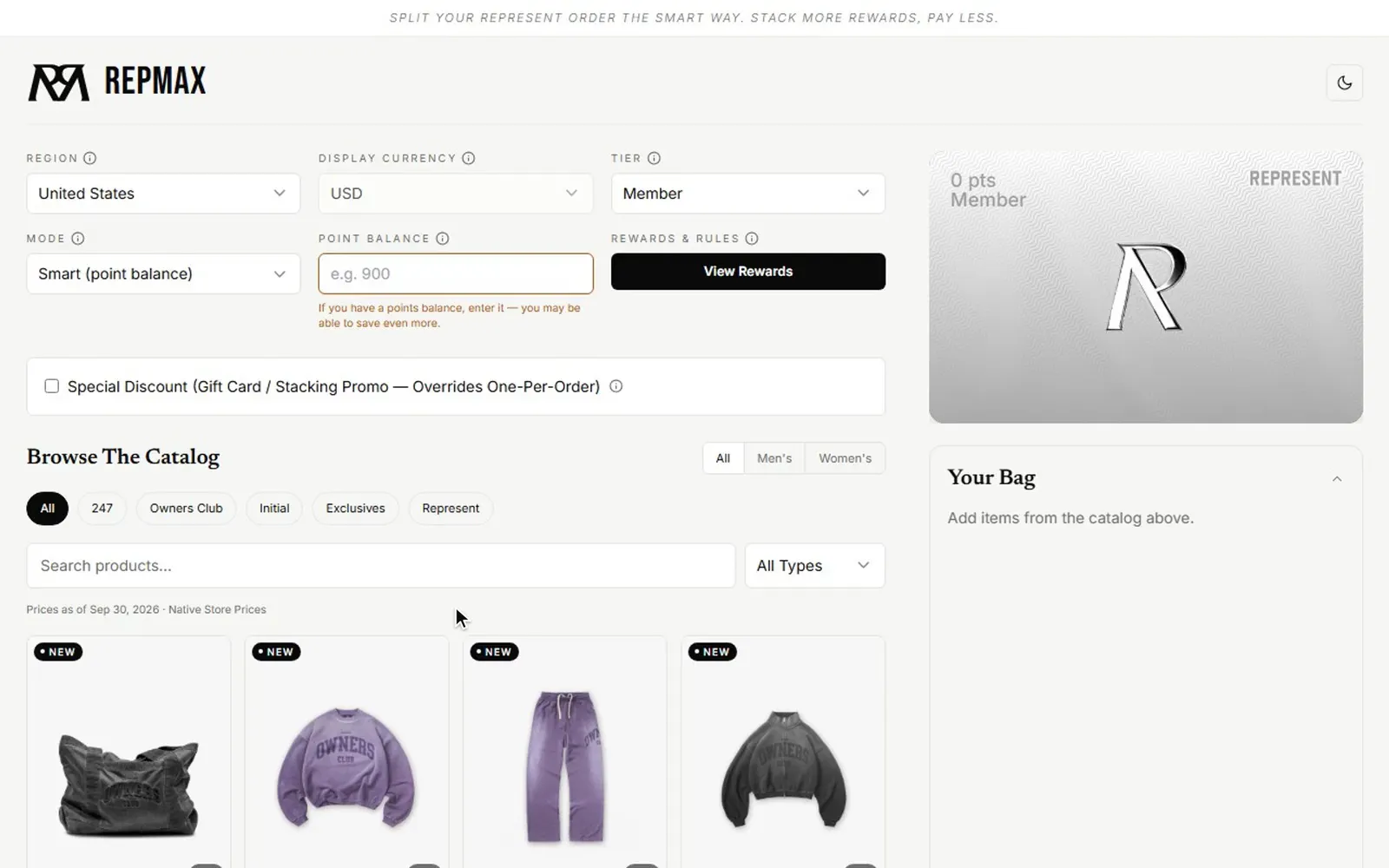
You give RepMax your bag, your membership tier and your points. It finds the best possible split and tells you which code to use on which order, with no account needed.
02 / 08
The £98 Question
The first version got the math right, but shoppers couldn't tell what they'd actually pay. One Reddit comment showed me, so I put the price first.
I launched RepMax on May 31 and shared it on Reddit. Soon after, this comment came in.
“So ive given it a try, made a bag which costs 210£ before discounts or anything and at the end it says saved 112£. Does this mean i can buy this items for 98£ in total? How does that work explain me pls 😂”
Yes, they could. They'd pay about £98. But the screen led with “£112 saved” and never showed the total. They had to do the subtraction themselves, and then they didn't trust the answer.
It never explained how, either. Nothing said to place separate orders and use one code on each, so a big saving looked too good to be true.
So I rebuilt the plan around the price. The bag total is struck through, and what you pay is the biggest number on screen. One line under it says how many separate orders to place, and each order says which code to use.
I also replaced a cryptic “vs single order +£70” stat with a plain comparison. It shows what you'd pay in one order, what you pay with the split, and the difference. Now anyone can check the saving for themselves.
Before, the plan led with what you'd save and left the price to work out.
The number people asked for now comes first, with the saving as the supporting line.
The working sits right under the price, so the saving can be checked rather than trusted.
03 / 08
Who Used It
It reached shoppers in 54 countries without a single ad, and most of them were on their phones.
RepMax reached shoppers in 54 countries. The UK sent the most (43%), then Canada (14%) and the US (12%). The whole launch was Reddit, LinkedIn and the Represent fan group, with no ads.
Between them, 528 people optimized a bag around 1,300 times, and shoppers added roughly 2,300 products to their bags.
I set up analytics and event tracking at launch, so I could see what people did, not just how many came. Within a day, the numbers showed most of them were on phones. Today that's 71% of visits.
They also showed a problem. On the first phone version, lots of people added products to their bag and then dropped off. Something in that flow wasn't right.
So I went back to the drawing board. The phone version had to feel natural and deliberate, not like a squeezed-down desktop page. On June 1 I rebuilt it twice. First the bag became a sheet that pulls up from the bottom. Then setup shrank to a few taps, and the shop took over the screen.
On a phone, setup is a region, a tier, a mode and a points balance.
Shoppers can search, filter by collection and open any piece to see all its photos.
Then the catalogue fills the screen, and the bag waits in a bar at the bottom.
Optimize turns the bag into the plan in the same sheet, ready to follow order by order.
Word got around further than I expected, all the way to Represent.
04 / 08
The Brand on the Other End
Their Head of Ecommerce commented on my post, then got in touch privately.
This was a brand I'd bought from for over ten years, and it's no small one. In 2024 it said it was on track for a record £100m turnover (Retail Gazette). Its Instagram has close to a million followers, and its fan group has over 16,000 members.
Ricky Jennings, Represent's Head of Ecommerce, left a comment on my LinkedIn post about RepMax.
“Wow insane. Great work”


Soon after, on June 11, he messaged me privately.
05 / 08
A Gap I Hadn't Seen
Ricky's team liked it, but one step let members get around early access.
The last step of each plan was a shortcut. You picked your sizes, and RepMax opened Represent's store with that order already in the cart.
That shortcut was Ricky's concern. It let members reach products before they were released to them, getting around early access. He asked if I could limit it.
He was clear that the team loved the site and the work behind it, and weren't asking me to take it down. They just needed locked products to stay locked.
I told him I'd fix it, so the Prestige program stayed fair for everyone. He also invited my ideas for their website and app.
06 / 08
Closing the Gap
I removed the shortcut. Shoppers now get a link to each product, and Represent keeps its own checkout.
On August 20 I took the cart shortcut away from shoppers. Each order now opens a short list of its items, and each one links to its page on Represent's own store.
Each item still shows whether your size is in stock, so you know before you click. Then you choose sizes and check out on Represent's store.
RepMax still does the hard part, working out the split. Represent stays in charge of what members can buy, and when.
Fixing it wasn't my only reply to Ricky. I'd also taken him up on his invitation.
07 / 08
An Idea for the Brand
I pitched Represent a way for members to share their sizes, so gifts would arrive in the right one.
In my reply to his message, I sent a one-page concept called The Wardrobe. Members could choose to share what they own, and their sizes, with friends and family. Then gifts would arrive in the right size.
RepMax helped members pay less. This idea went the other way, helping Represent sell more with no discount at all. Sizes would come from what members had bought and kept, so nobody typed anything in.
A friends & family gifting concept for Represent
The Wardrobe
Let your closest people see what you own, what fits, and what's safe to buy.
01The problem
Gift orders are the riskiest orders in fashion ecommerce — wrong size, duplicate item, wrong colourway. They convert hesitantly, return expensively, and spike exactly when the store is busiest: sale events and Christmas. Every gift shopper has the same two questions — what do they already have, and what size do they actually wear? Right now, nobody can answer either.
A friend opens my private link, with the sizes I actually wear up top.
They see what I already own, and what I sent back, so they don't buy it twice.
They pick a gift, and my size is already chosen from what I kept.
At checkout they set a gift date. The order and my points stay hidden until then.
The gift is booked, and the surprise is safe.
A rough working prototype I built of the idea: real Represent products, a made-up wardrobe. Not a Represent feature.
- Today
The gift is ordered. Brenden sees nothing.
- Dec 24
Still hidden. No early points to give it away.
- Dec 25
The order and his Prestige points appear.
Opt-in only · item-level hiding · expiring, revocable links. Built for UK GDPR from day one, not retrofitted.
Because you're a British brand. "Closet" never felt right.
A concept by Brenden — Represent customer, unaffiliated. Always happy to talk it through.
Nothing came of it. Looking back, the pitch mattered less than the problem that led to it.
08 / 08
What I Ask Sooner Now
A correct answer isn't enough. People need to see the working, and the business on the other side needs its rules kept.
I built RepMax to save myself some extra dollars and napkin math. The community showed me they wanted to use it too. A Reddit comment taught me to show how it works, not just the answer.
The analytics taught me to watch what people do, not what I expect them to do or how I assume they'll use the app.
Ricky's message taught me something harder. I'd been a Represent customer for over ten years, and I still hadn't looked at RepMax from their side. A feature that saves one person money can quietly break someone else's rules.
Now I ask how something could be misused before I ship it, not after.
RepMax is still live, and its plan still leads with the price you'll pay. Try RepMax.
Aside
Two R's, One M
The RepMax logo is two R's. The second one is flipped, so together they read as an M.
Next case study
Traced logos looked right but carried 36 times the nodes a designer would draw.